

 Login
Login

 Free Trial

 Server Config


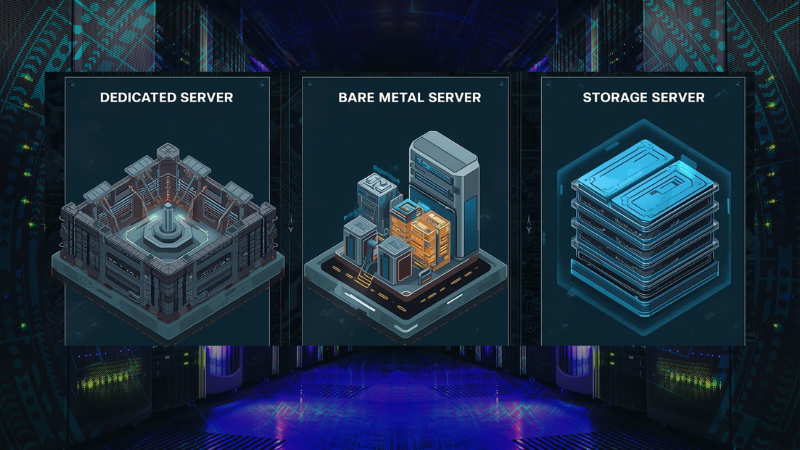
The foundation of any robust digital strategy lies in selecting the right server infrastructure. Today’s organizations face a spectrum of data challenges—from powering AI and analytics to supporting global eCommerce, media streaming, and secure financial transactions. As workloads diversify and scale, understanding whether dedicated servers, bare metal servers, or storage servers are best suited to your operational needs is fundamental to driving performance, compliance, and business growth.
Key Takeaways
- Dedicated servers deliver consistent, isolated resources and are optimal for stable, high-security applications that demand predictable performance.
- Bare metal servers combine the flexibility of cloud-native provisioning with the power of direct hardware access, excelling in dynamic, resource-intensive, and latency-sensitive environments.
- Storage servers offer scalable, secure, high-capacity data repositories, ideal for backup, archiving, disaster recovery, and big data analytics.
- Choosing the right infrastructure requires a clear understanding of workload patterns, regulatory requirements, and future growth trajectories.
- XLC’s solutions enable seamless deployment across strategic global data centers, ensuring low-latency access, regulatory compliance, and tailored configurations for any workload.
Dedicated Servers: Stability and Full Control for Critical Applications
Dedicated servers are known for their exclusive allocation of hardware resources. They provide single-tenant environments, meaning every CPU cycle, gigabyte of RAM, and storage block is reserved for your application alone. This ensures consistent performance and eliminates the “noisy neighbor” effect found in multi-tenant setups.
Typical Use Cases:
- High-traffic eCommerce and enterprise websites
- Financial systems requiring strong compliance (e.g., PCI DSS)
- Corporate databases and ERP platforms
Key Features:
- Full root/admin access
- Customizable OS and software stack
- Predictable monthly/annual billing
- Enhanced physical security and compliance
Bare Metal Servers: Maximum Performance and Rapid Deployment
Bare metal servers provide raw hardware without pre-installed virtualization layers, enabling direct access for custom workloads. They are often provisioned in minutes, supporting cloud-native operations such as API-driven deployments and on-demand scaling. This makes them ideal for modern workloads where speed, flexibility, and performance are vital.
Typical Use Cases:
- Machine learning, AI model training, and analytics
- High-frequency trading, real-time gaming platforms
- Media rendering farms and video streaming services
Key Features:
- Direct-to-hardware provisioning
- Flexible billing (hourly, monthly)
- Support for custom hypervisors, containers, and virtualization
- Low-latency, high-bandwidth networking
Storage Servers: Purpose-Built for Data Growth and Protection
Dedicated storage servers are engineered for massive data capacity and robust redundancy. They provide secure, centralized storage for backups, archiving, disaster recovery, and analytics, with options for custom drive arrays, RAID levels, and private network integration.
Typical Use Cases:
- Enterprise backup and DR solutions
- Media library hosting and video archives
- Big data and compliance-driven data retention
Key Features:
- Up to 24 drives per server for scalable capacity
- Integrated RAID for redundancy and speed
- Private networking for secure, high-speed data transfer
- Flexible storage media (SAS, SSD, hybrid)
Comparison Table: Dedicated vs. Bare Metal vs. Storage Servers
| Aspect | Dedicated Server | Bare Metal Server | Storage Server |
| Target Use Case | Stable, secure applications | High-performance, dynamic workloads | Data storage, backup, archiving |
| Provisioning Speed | Hours to days | Minutes to hours | Hours to days |
| Customization | OS, hardware, software | Full hardware/OS/hypervisor access | Drives, RAID, networking |
| Billing Model | Fixed monthly/annual | Hourly or monthly (cloud-like) | Fixed monthly/annual |
| Cloud-Native Features | Limited | Extensive (API, automation) | Integrates via private network |
| Performance | Consistent, predictable | Maximum, hardware-level | Optimized for storage I/O |
| Security/Compliance | High | High | High (data-centric) |
| Scaling | Manual | Automated/manual | Manual (add drives/capacity) |
Industry Workload Table
| Industry / Workload | Ideal Server Type | Reasoning |
| AI & Machine Learning | Bare Metal Server | Direct hardware access, rapid provisioning |
| Financial/Fintech | Bare Metal/Dedicated | Low latency, compliance, predictable transaction speed |
| eCommerce | Dedicated Server | Stable performance, PCI DSS compliance |
| Media & Streaming | Bare Metal/Storage Server | High throughput, scalable storage, low-latency delivery |
| Backup & Archiving | Storage Server | High capacity, redundancy, secure data retention |
| Gaming | Bare Metal/Dedicated | Low latency, global reach, real-time performance |
Frequently Asked Questions
How do bare metal servers differ from dedicated servers?
Both are single-tenant, physical servers. Bare metal servers are typically provisioned more quickly, often with cloud-native features and flexible billing, while dedicated servers follow a more traditional model with fixed contracts and configurations.
Can I virtualize workloads on both server types?
Yes. Bare metal servers are often chosen for their ability to run any hypervisor or container platform. Some dedicated servers may have restrictions based on provider.
When is a storage server preferable?
Choose storage servers for tasks where data capacity, redundancy, and backup are the focus, such as archiving, disaster recovery, or supporting analytics.
How does XLC support global workloads?
XLC offers infrastructure in Hong Kong, Los Angeles, and Tokyo, with customizable server configurations, high-speed bandwidth, and compliance support for cross-border operations.
Conclusion
Choosing the optimal server infrastructure is a pivotal decision for any business aiming to excel in a rapidly evolving digital environment. The right combination of dedicated, bare metal, and storage servers not only ensures seamless performance and security but also provides the agility to adapt as your workload demands change.
For organizations seeking a balance of reliability, customization, and scalability, XLC’s Dedicated Bare Metal Servers deliver direct hardware access, rapid provisioning, and flexible configurations—empowering you to tackle performance-sensitive or dynamic applications with confidence. If your priority is managing expanding data requirements, XLC’s Dedicated Storage Servers offer robust, high-capacity solutions designed for secure backup, archiving, and data-centric workloads.
With a global presence in strategic data centers and a commitment to enterprise-grade infrastructure, XLC enables businesses to deploy, scale, and protect their most critical projects—no matter where growth takes you. Explore how XLC’s Dedicated Bare Metal Servers and Dedicated Storage Servers can help power your next wave of innovation.
